The NYTimes journalist who reported about Manifest, also mentioned Manifold in a podcast. As it was mentioned in the Manifold Discord, mqp wondered:
it makes me think more like, i wonder if it's impossible to make a "normal person" understand the idea of "i make the most money by moving the market to my true probability", and is there a way to get them to do that behavior without understanding it in those terms
The comment references this comment by cata on Lesswrong:
At the end when they were making the market, Casey wasn't like "OK, bet it to 25%, since I think that's the chance." Instead Kevin was like "OK, I'll bet 100 mana," and then they were like "Huh, how about that, now it says 10%. Oops, I bet 100 more and now it says 8%." It seems like they are totally missing the core concept that the point of the prediction market is trying to specifically incentivize you to move the market to the probability you believe, which is like the first thing I ever learned about prediction markets in my life?
Which in turn references this part of the podcast:
Kevin Roose: OK. Is the CEO of X — and then we have to create our resolution criteria. If she no longer has that title on April 13, 2024, this market will resolve to no. Otherwise, it will resolve to yes. So what’s your bet?
Casey Newton: My bet is no.
Kevin Roose: So we’re going to bet 100 mana on this. And that is going to move the probability by 40 percent down to just 10 percent.
Casey Newton: So — oh, because we bet so much.
What did Kevin and Casey do “wrong”?
They treated it like a bet: You have to pick if you bet on YES or NO and how much to bet. It isn’t really “wrong” as you can gamble like that on Manifold, but there is a subtle issue. If you are ignorant about that, it isn’t a profitable strategy.
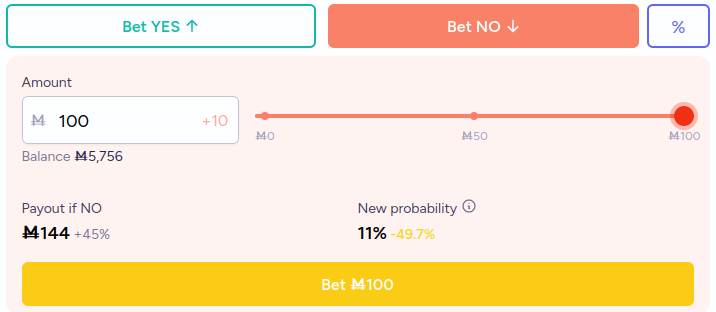
Note that Manifold shows “Payout if NO 144 Mana”. Kevin and Casey might expect 1:2 odds for their bet, since the question is at 50% initially. Investing 100 Mana for a return of 144 Mana are worse odds though, 25:36 to be precise.
What would Marketwise do? (Probably also what mqp and cata would do.) Here it is in three steps.
Step 1: What is YOUR probability?
You should not “bet on NO”. Instead, ponder about the probability and ask “how likely is it?” You are never completely sure about something, so the answer will not be 0% (NO) or 100% (YES). It could be something like “33%” for something “unlikely”.
To come up with numbers like 33% doesn’t come naturally. Let’s look at an example, where we can calculate it without guessing. Assume you play poker. It always starts with a deck of 52 cards. You get some on your hand and some get placed on the table.
First, we need to know how many cards are left in the deck. It depends on how many players there are, what kind of poker you play, etc. Well, in a specific situation, we simply count. For our example, let’s say 36 cards (of 52) are still in the deck.
Second, how many cards of those would secure you a win? Maybe you have four spades and hope for a fifth to complete your flush; you have a flush draw. That means 9 spades are out there.
Our chances are 9/36 which is 25%. Decent poker players know such probabilities. They will then use experience and gut feeling to adapt it slightly but the base number comes from hard math.
Today we are not going into detail how to arrive at such a number but whenever you bet, you should have one in mind.
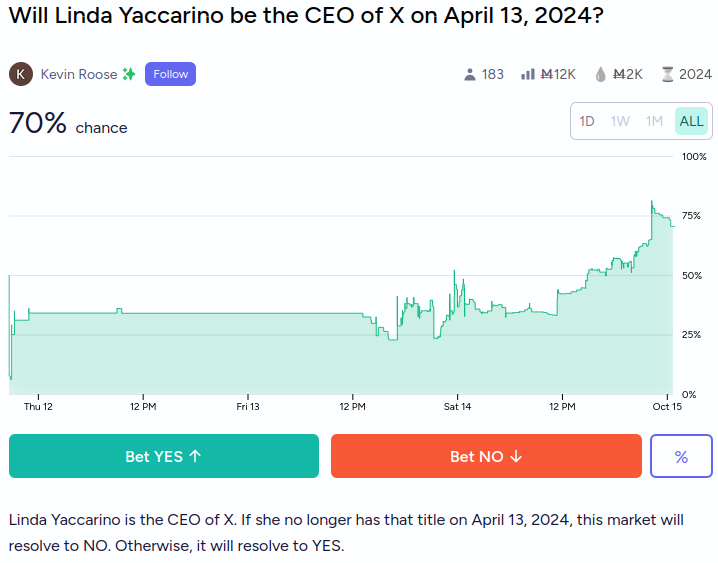
At Metaculus, this is all you need. No need to think about money. You can skip the other steps.
Step 2: How much to bet?
Kevin decided to bet 100 Mana. Is there a math answer for this one, too? Yes, it is called Kelly-Criterion. The Manifol.io webapp can do the calculations for you.
One limitation is your balance: If you don’t have much Mana, you cannot bet much. You also should diversify your bets instead of betting everything on one question. This lowers the risk of going bankrupt.
Another limitation is the market you are betting on. At a Poker game the amount of money in the middle, the pot, is a similar limit. With markets, we call it “liquidity” or “volume”. Casey was surprised the market moved down “by 40 percent”. If it were more liquid the 100 Mana bet would have moved it less drastically. Here is a 1,460,968 Mana volume market. If you bet 100 Mana there, it will not move at all.
If you want a simple rule of thumb, try this one: Bet the market half-way to your probability and only 1% of your net worth. As an example:
-
If a market is at 40% and I believe it should be at 20%. I move it down to 30% at most.
-
My net worth is currently 34,683 Mana, so my bets should be less than 350 Mana.
This rule is actually too much on the safe side, but that is fine at first. Later, you can optimize profits.

Step 3: Bet safely
The price moves in real time. How do you actually make bets in practice? The trick is called “limit orders”. You write down your probability, so you never bet too much accidentally.
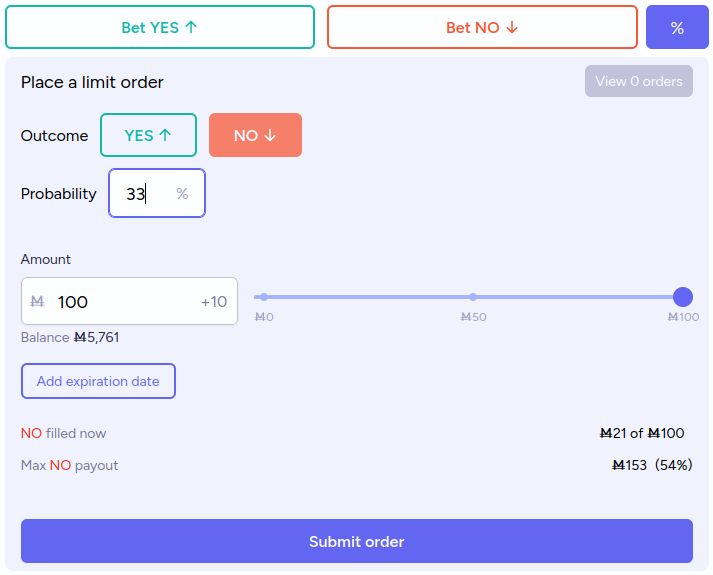
By the way, limit orders are also nice with bots (like acc) which might immediately buy against you. You get a slightly better price this way.
Step 3b: Cancel the limit order. By default they stay there indefinitely. You might believe the probability is 33% today, but you might change your mind later.
🔗 Links Links Links
-
Will Iran develop a nuclear weapon? (INFER Issue Report October 2023) [pdf] Nice description how they break down a question and how they discuss sub-questions with argument to raise or lower their percentage.
-
TDN Launches Prediction Market. A horse racing website will integrate prediction markets into their articles.
-
Comparing Two Forecasters in an Ideal World describes how hard it is to figure out who is the better oracle.
There is so much more going on the world of forecasting than I can cover here. I created a Fediverse community c/forecasting to collect stuff I come across. Here is the hand-selected best-of. Let’s see if there will be enough for a regular section.
Probably until next week, clever readers! 😊